









AI-Led On-Call for the Indexes Behind $21 Trillion in Assets

- Industry
- Financial Services
- Company
- MSCI
Oct 14, 2026
About MSCI
MSCI is a global leader in financial data and investment decision-support, with more than 55 years of experience measuring global equity markets. Today, MSCI calculates hundreds of thousands of equity indexes daily, with $21 trillion in assets benchmarked to its indexes and $2.8 trillion in ETF assets linked to them. Its customers include some of the world’s largest asset managers, hedge funds, pension funds, and banks, which rely on MSCI data to make critical investment decisions on fixed, non-negotiable timelines.
For MSCI, reliability means delivering accurate data exactly when customers expect it, making accuracy and timeliness two of the key measures reported to leadership every quarter.
MSCI’s MTTR problem
If MSCI has any downtime or latency, the consequences can have a direct impact on its customers who use MSCI’s data to make multi-billion-dollar investment decisions.
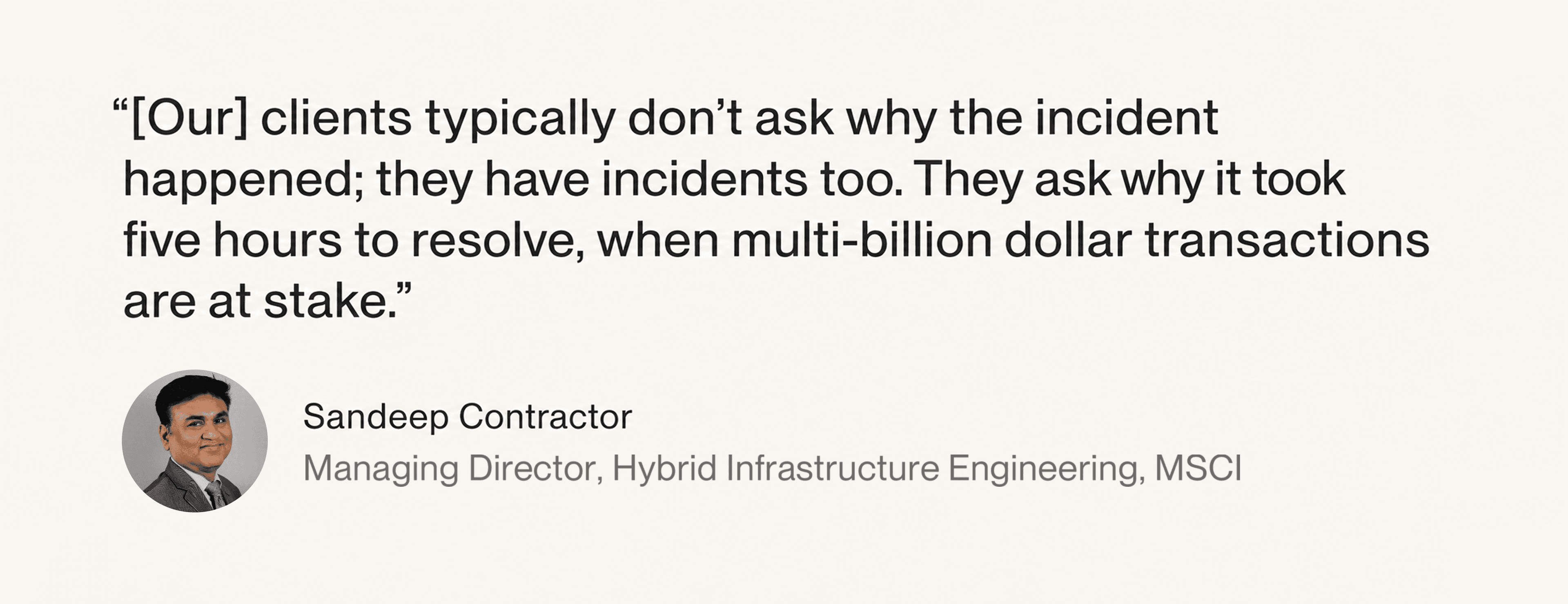
MSCI had more than 12 observability tools across its estate when the partnership with ResolveAI started. Teams across MSCI were consistently detecting issues; however, the real challenge was resolving those issues quickly enough to limit customer impact. When an alert fired, teams across network, data, platform, and application engineering jumped into their respective monitoring tools to investigate. But frequently, each came back with the same answer: “Not us.”
After escalation, a separate team then had to piece those answers together to determine where the problem actually lived, and, in many cases, it took three to four hours just to identify the true system at fault, before mitigation or remediation could even begin. Major incidents could pull more than 60 engineers onto a single bridge call for four hours or more. That meant hundreds of engineering hours and thousands of dollars spent operationally managing a single incident, before accounting for the customer impact of the incident itself.
This seemingly endless investigation cycle was becoming extraordinarily costly for MSCI. Teams could detect incidents quickly, but finding the root cause of the incident could still take hours.
For MSCI’s customers, every minute of downtime could mean making critical investment decisions without the data they rely on. MSCI needed to fundamentally change how its teams investigated production.
Why ResolveAI?
MSCI leadership saw two paths forward to address their MTTR challenges.
The first was to consolidate their collection of observability tools. Fewer tools would equate to fewer places for engineers to have to look during an investigation. Still, an engineer would have to take signals from different systems and piece them together into an explanation of what was happening in production.
The second path was to deploy an AI reasoning layer across their stack.
MSCI ultimately decided to pursue the latter first, choosing ResolveAI to become the AI layer for incident management across its 12+ observability tools.
Production at MSCI wasn’t a clean repository that an AI system could easily ingest. Critical knowledge lived across tools, documentation, and inside the brains of engineers who had spent years working with the environment. MSCI and ResolveAI had to build that context together.
ResolveAI met MSCI’s requirements as an AI reasoning layer across three areas:
- Cut MTTR. ResolveAI was proven to provide faster accurate root cause analysis backed by production evidence in other customers like DoorDash and Coinbase.
- Extensibility. Rather than forcing MSCI to replace its existing tooling, ResolveAI could fit into the systems its teams already use and accurately correlate information in real time.
- Partnership. ResolveAI’s team worked directly with MSCI engineering to build integrations and document systems that had never sent logs or had their production context captured in one place before.
ResolveAI’s impact on MSCI’s L1 on-call
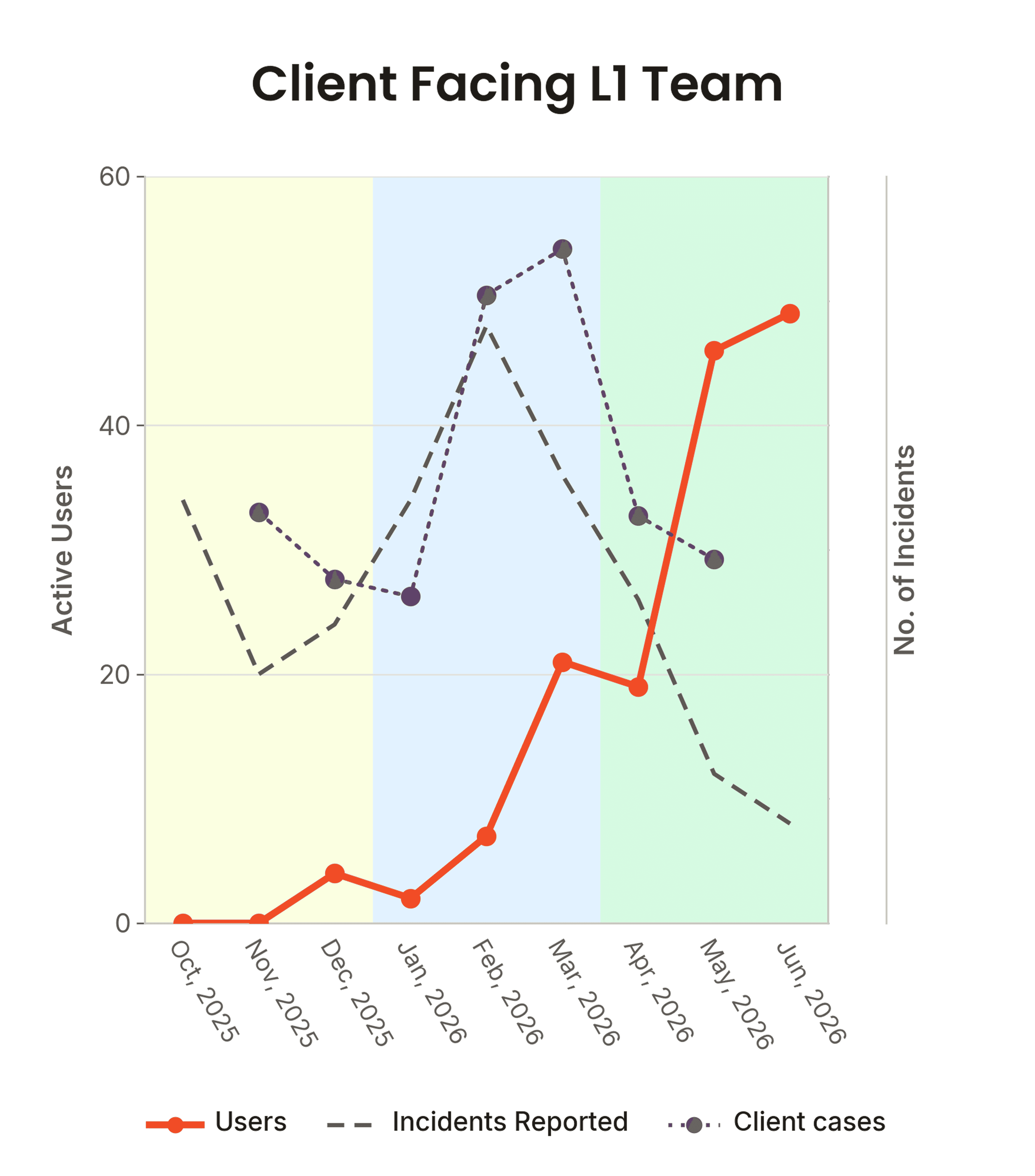
As adoption of ResolveAI spread across MSCI, a similar pattern began appearing across its teams: ResolveAI usage increased while reported incidents fell by roughly three quarters.
On one infrastructure team, reported incidents fell by 77%, as active users grew more than 10x.

Additionally, MSCI’s critical client-facing L1 team saw nearly the same type of impact as the team experienced a 76% decrease in reported incidents while ResolveAI adoption grew over the same period. Impact extended to MSCI’s customers, too, where client cases dropped 46% from their peak by June 2026.
How ResolveAI reduced incidents
Historically, MSCI could spend three to four hours just determining which system was responsible for an incident. In one particularly complex P3 incident, ResolveAI traced the issue to its root cause in 14 minutes, up to 17x faster than MSCI’s historical investigation time.
The incident started with failed index calculations, but the application itself wasn’t the problem. Five separate signals were firing across the stack: more than 200 network MAC moves, a 39-minute Kubernetes networking stall, failed retransmits on a compute node, traffic hitting a retired server, and a control-plane hiccup.
Individually, none of those signals explained the incident, and each lived in a different tool or infrastructure layer.
ResolveAI correlated all five into a single causal chain and traced the issue to a hardcoded IP address still pointing at a server that had been retired months earlier. Time to root cause: 14 minutes.
By connecting those signals early, ResolveAI helped MSCI address the underlying issue before the P3 could escalate into a more severe incident with greater customer impact.

Flipping on-call on its head
Although faster MTTR is a massive win for the MSCI team, the biggest change internally has been in who, or what, starts their investigations.
Before ResolveAI, an alert would fire and a human had to figure out where to start. Now, an alert lands in PagerDuty, ResolveAI joins the incident channel via Microsoft Teams, and the investigation starts automatically. By the time an engineer engages, ResolveAI has already started building a working theory of what happened and why.
Today, more than 80% of MSCI’s critical incidents are triaged by ResolveAI first
Humans have moved away from being in the loop of every investigation. As MSCI describes it:
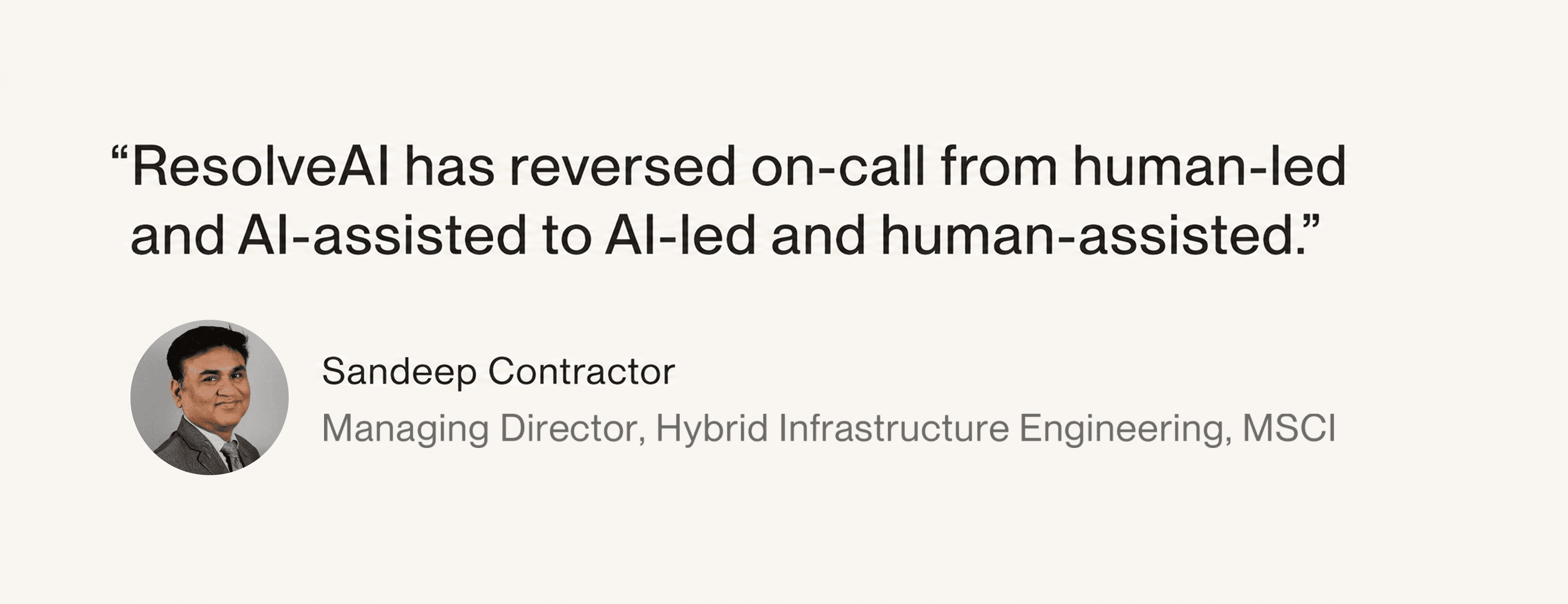
Machines are now on-call for humans at MSCI.
Extending ResolveAI beyond on-call
Incident management is the starting point. The integrations and context MSCI built with ResolveAI can now be reused across production.
MSCI is now extending ResolveAI into three additional workflows:
- Code changes. Evaluate the risk of planned ServiceNow changes before they ship.
- Service capacity management. Identify where capacity is constrained and which services are consuming it.
- Checkout health. Automate routine health checks, pre-deploy verification, and environment validation.
Each builds on the same foundation MSCI and ResolveAI originally created for incident response.
Where we’re heading: Autonomous Reliability
For MSCI, reversing on-call is the first step. Today, ResolveAI leads the investigation while engineers drive the fix. The next step is letting ResolveAI take on more of the resolution itself, with engineers stepping in where judgment or approval is needed.

AI SRE Buyer's Guide
Learn how to evaluate and adopt AI SRE in production.
Want to see why leading companies trust Resolve AI?
Learn how engineering teams are transforming software engineering with agentic AI.
